POPE LEO XIV DECLINES TO PRAY AT BLUE MOSQUE DURING ISTANBUL VISIT, BREAKING WITH PREDECESSOR TRADITION

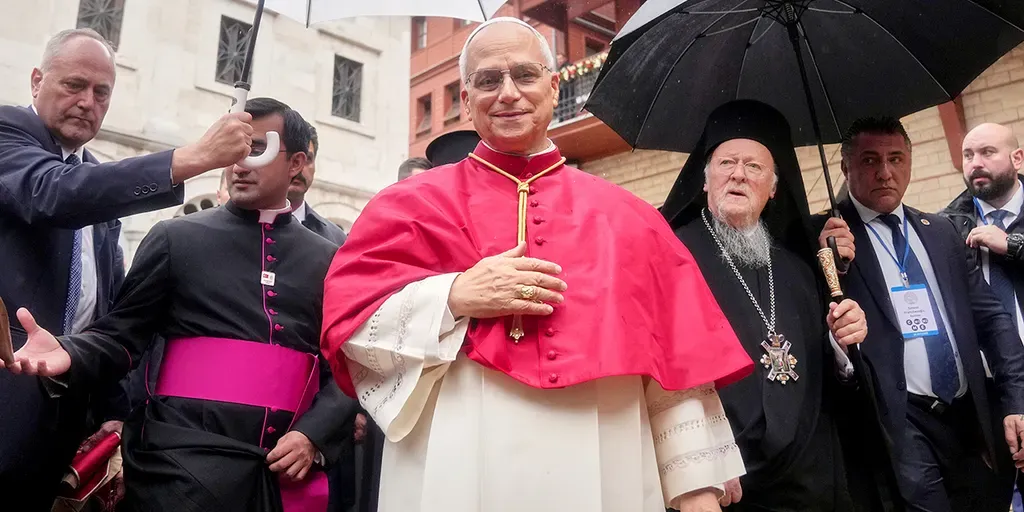
Pope Leo XIV visited Istanbul's Blue Mosque on Saturday, November 29, 2025, but declined an invitation to pray there, breaking with the tradition established by his two immediate predecessors during their visits to the historic mosque.
The 70 year old pontiff, history's first American pope, toured the 17th century Sultan Ahmed Mosque for approximately 20 minutes, removing his shoes and walking on the burnt orange carpet in white socks as a sign of respect for the Islamic place of worship.
However, when Imam Asgin Tunca invited Pope Leo to pray in what he called "Allah's house," the pontiff politely declined, replying "That's okay" according to the imam's account to journalists. Another report indicated Leo said
"No, I am just going to look around."
The Vatican had originally briefed the press to expect Leo would observe a "brief moment of silent prayer" at the mosque, but after the visit the Holy See issued a corrected statement removing that reference without explanation.

Vatican spokesman Matteo Bruni later said, "The pope experienced his visit to the mosque in silence, in a spirit of contemplation and listening, with deep respect for the place and the faith of those who gather there in prayer."
The decision marks a departure from recent papal precedent. Pope Francis prayed in "silent adoration" during his 2014 visit to the Blue Mosque, while Pope Benedict XVI observed a moment of silent prayer during his 2006 visit, head bowed as the imam prayed next to him facing east.
Pope Benedict's visit came just months after he sparked controversy and protests throughout the Muslim world by quoting a 14th century Byzantine Emperor Manuel II Palaiologos describing Islam as having been spread "by the sword" in an "evil and inhuman" manner. The Blue Mosque visit was added to his itinerary at the last minute as an outreach gesture to Muslims.
Pope John Paul II became the first pope to visit a mosque in 2001 when he toured the Umayyad Mosque in Damascus, Syria. While he offered prayers during that visit, the Vatican rejected demands that he remove his cross or apologize for the Crusades.

The Blue Mosque, built between 1609 and 1616 during the reign of Ottoman Sultan Ahmed I, is an architectural masterpiece with six minarets, cascading domes, and interior walls lined with vibrant blue Iznik tiles. It can hold 10,000 worshippers and remains an active mosque while also serving as one of Istanbul's main tourist attractions.
Pope Leo also broke with his predecessors by not visiting the Hagia Sophia, located across from the Blue Mosque. The Hagia Sophia served as one of Christianity's most important places of worship for approximately a millennium before being converted to a mosque for 500 years after the fall of the Byzantine Empire.

Turkey's secular republic converted it to a museum more than 70 years ago, but President Recep Tayyip Erdogan turned it back into a mosque in 2020. Pope Francis said in 2020 that he was "very pained" by the reconversion. The Vatican has not commented on Leo's decision to skip visiting the Hagia Sophia.
Following the Blue Mosque visit, Pope Leo met privately with leaders of local Christian churches before attending a service at the Patriarchal Church of Saint George alongside Ecumenical Patriarch Bartholomew I, the spiritual leader of Eastern Orthodox Christians.
Leo's visit to Turkey focuses on commemorating the 1,700th anniversary of the Council of Nicaea in 325 AD, which produced the Nicene Creed still used by most Christian churches. The pope is emphasizing Christian unity rather than interfaith dialogue during this inaugural foreign trip.
Turkey's Christian population has declined from approximately 20 percent in 1914 to just 0.2 percent today, with Catholics numbering only 33,000 in a country of more than 85 million people, most of whom are Sunni Muslim.

THE CRUSADER'S OPINION
Pope Leo XIV politely declined to pray in a mosque.
This should not require news coverage.
This should be automatic.
The fact that it is newsworthy reveals how far papal interfaith gestures have departed from basic Christian theology.
Catholics and Muslims do not worship the same God.
Allah is not the Father of Jesus Christ.
The Quran explicitly denies the Trinity, the divinity of Christ, the crucifixion, and the resurrection.
When Pope Francis prayed in "silent adoration" at the Blue Mosque, what exactly was he adoring?
When Pope Benedict bowed his head in "silent meditation" while the imam prayed to Allah, who was Benedict meditating on?
These are not minor theological questions.
They are fundamental.
Pope Leo's decision is not bold.
It is basic Christian confession.
A Christian does not pray in a house dedicated to a religion that calls Jesus a liar about His own identity.
The Blue Mosque is beautiful.
Tour it.
Appreciate the architecture.
Show respect to the people.
But do not pray there.
Because when you pray in a mosque, you are either praying to Allah, which is apostasy, or you are praying to the Christian God while standing in a building that declares Christ is not divine, which is spiritual confusion at best.
Pope Leo chose correctly.
This is not interfaith hostility.
This is theological clarity.
Christians and Muslims can cooperate on shared concerns.
They can respect each other's right to worship.
They can work together for peace and justice.
But they cannot pretend they worship the same God just to manufacture ecumenical warm feelings.
Truth matters more than gestures.
TAKE ACTION
- Thank Pope Leo XIV for declining to pray at the Blue Mosque and maintaining theological clarity about Christian worship. Contact the Vatican encouraging continued commitment to truth over interfaith symbolism that obscures fundamental theological differences.
- Vatican Secretariat of State: segreteria.stato@vatican.va
- Pray for Pope Leo XIV as he continues his Middle East trip to Lebanon, asking God to give him wisdom in navigating complex interfaith environments while maintaining clear Christian witness about Jesus Christ's unique identity and work.
- Support persecuted Christians in Turkey through organizations working with the country's tiny Christian minority of 33,000 in a population of 85 million. Fund relief efforts, advocate for religious freedom, and raise awareness about declining Christian populations in former Christian heartlands.
- Barnabas Fund: www.barnabasfund.org
- Open Doors: www.opendoors.org
- Educate churches about Christian-Muslim dialogue emphasizing cooperation on shared concerns while maintaining theological clarity. Oppose interfaith approaches that compromise Christian truth claims about Christ's divinity, death, and resurrection for sake of religious harmony.
- Pray for Turkey's Christians who face immense pressure as 0.2 percent minority in overwhelmingly Muslim nation. Support their witness, fund their ministries, and advocate for protection of their rights including restoring Christian access to historically significant sites like Hagia Sophia.
- Study the theological differences between Christianity and Islam to understand why Christian prayer in mosques creates confusion. Learn about Islam's explicit denial of Trinity, Christ's divinity, crucifixion, and resurrection to explain why interfaith prayer is theologically problematic.
- Recommended resource: Answering Islam by Norman Geisler and Abdul Saleeb