
BRUSSELS NATIVITY VANDALIZED: Baby Jesus Stolen From Controversial Display

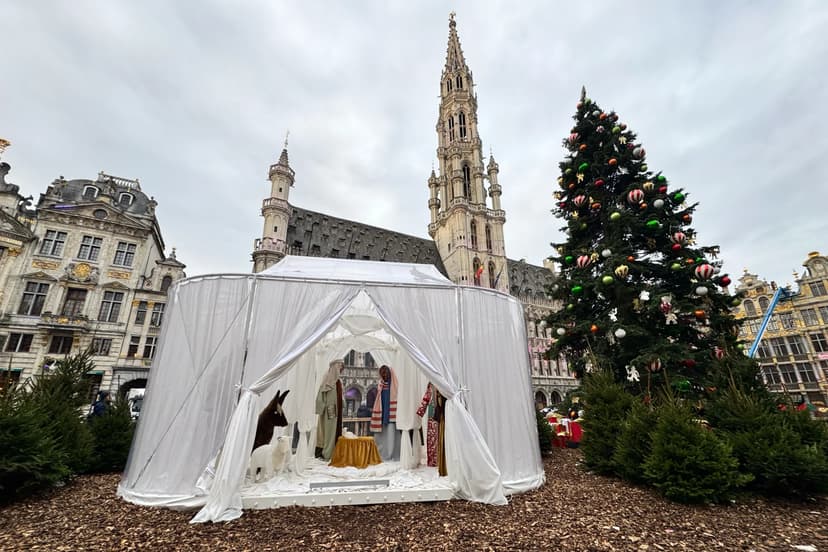
A figure of infant Jesus was stolen from a Christmas nativity scene on the Grand Place in Brussels, Belgium between late Friday night and early Saturday morning, November 29 to 30, 2025.
The nativity scene has been at the center of controversy on social media because the faces of all characters lack eyes, noses, and mouths. Artist Victoria Maria Geyer crafted the nativity figures out of cloth, intending that the faithful from Japan to Namibia would see themselves in the soft fabrics lacking any identifying features.
Geyer said she designed the figures so that "every Catholic, regardless of their background or origins can identify themselves" in the biblical story of the birth of Christ. The self professed devout Catholic's work was selected by both the local Catholic church and the City of Brussels in an annual tradition.

Georges Louis Bouchez, head of the center right MR party which is part of Belgium's ruling coalition, said in a post on X that Geyer's cloth Christ "in no way represent the spirit of Christmas." He compared the figures to "zombie like" people found at train stations.
The nativity scene is displayed in a simple white tent at the center of Brussels' Grand Place, beneath an enormous Christmas tree. The location hosts one of Europe's largest Christmas markets, which attracted more than 4 million visitors last year to shop at 238 vendors and enjoy mulled wine and hot chocolate.
Delphine Romanus, deputy director of Brussels Major Events which manages the manger and market, confirmed the theft and said that in the past other baby Jesus figurines have been broken or stolen. Early reports that the infant Jesus had been beheaded are false.
Authorities have already replaced the baby Jesus in the crib. Organizers and security say they will keep a closer eye on the manger but have not taken additional precautions.
An initial deluge of negative comments on social media has turned positive, according to Geyer.
Brussels resident Francis De Laveleye criticized the controversy, stating, "What is intolerable is that people attack the work of an artist to damage it and to turn it into a kind of stupid little controversy that ridicules Brussels."
The Grand Place Christmas market and nativity scene are an annual tradition in Brussels' historic old city center, drawing millions of visitors during the Christmas season.

THE CRUSADER'S OPINION
A faceless Christ stolen from a nativity scene that depicts Christ without a face.
The irony writes itself.
The artist claims removing Jesus' eyes, nose, and mouth allows universal identification with His birth.
This is theological nonsense disguised as inclusivity.
Jesus was not a blank canvas for people to project themselves onto.
He was a Jewish man born in Bethlehem with a specific face, specific features, and a specific identity.
The Incarnation means God took on flesh.
Real flesh.
Not abstract cloth without features.
When you strip Christ of His identifying characteristics in the name of universal appeal, you have not made Him more accessible.
You have erased Him.
A politician compared these figures to zombies at train stations.
He is right.
This is what happens when artistic expression matters more than theological truth.
The theft is wrong.
But the statue itself represents something far worse: the modern impulse to remake Christ into whatever makes people comfortable rather than confronting who He actually is.
Jesus came with a face.
He comes to be worshiped, not reimagined.
TAKE ACTION
- Support traditional sacred art by donating to organizations preserving classical Christian imagery that depicts Christ faithfully according to Scripture and Church tradition. Contact the Confraternity of Catholic Clergy demanding Brussels replace faceless figures with traditional nativity.
- Confraternity of Catholic Clergy: www.catholicclergyconference.org
- Email: info@catholicclergyconference.org
- Contact the City of Brussels expressing concern that faceless nativity figures distort the Incarnation and requesting traditional sacred art be used for public Christian displays during Christmas season.
- Brussels Major Events: info@brussels.be
- Educate your church about the importance of accurate sacred art depicting Christ's true Incarnation rather than abstract representations that erase His specific Jewish identity and historical reality as presented in Scripture.
- Support traditional nativity scenes in your community by volunteering to set up displays that accurately depict the birth narrative with recognizable human features, ensuring Christmas imagery reflects theological truth about the Incarnation.