This Horrible Abyss That We Make- A reflection from the Gospel of Luke
Jesus said to the Pharisees:
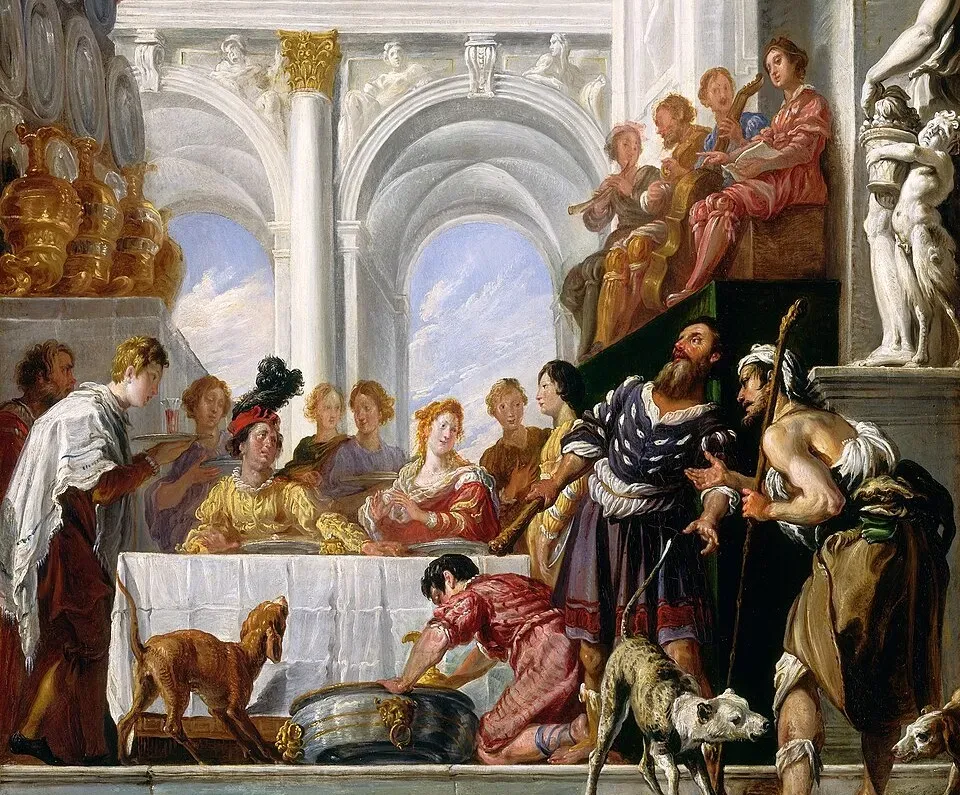
“There was a rich man who dressed in purple garments and fine linen and dined sumptuously each day.
And lying at his door was a poor man named Lazarus, covered with sores, who would gladly have eaten his fill of the scraps that fell from the rich man’s table. Dogs even used to come and lick his sores.
When the poor man died, he was carried away by angels to the bosom of Abraham. The rich man also died and was buried, and from the netherworld, where he was in torment, he raised his eyes and saw Abraham far off and Lazarus at his side.
And he cried out, ‘Father Abraham, have pity on me.
Send Lazarus to dip the tip of his finger in water and cool my tongue, for I am suffering torment in these flames.’
Abraham replied, ‘My child, remember that you received what was good during your lifetime while Lazarus likewise received what was bad; but now he is comforted here, whereas you are tormented. Moreover, between us and you a great chasm is established to prevent anyone from crossing who might wish to go from our side to yours or from your side to ours.’
He said, ‘Then I beg you, father, send him to my father’s house, for I have five brothers, so that he may warn them, lest they too come to this place of torment.’
But Abraham replied, ‘They have Moses and the prophets. Let them listen to them.’
He said, ‘Oh no, father Abraham, but if someone from the dead goes to them, they will repent.’
Then Abraham said, ‘If they will not listen to Moses and the prophets, neither will they be persuaded if someone should rise from the dead.’”
— Luke 16:19-31
Hell is something that I ponder on frequently. It’s sometimes difficult to grasp why a loving God would allow so many of His beloved children to burn and suffer for all eternity. Isn’t that also one of the most common objections that atheists give when voicing their resentment against the Creator?
I love questioning stuff like this and letting God answer me. He shows His infinite wisdom and His paternal guidance by continuously guiding me through my inquiries. Like a good teacher, I believe He encourages a healthy level of skepticism and a spirit of genuine curiosity, and He rewards it with knowledge, certainty, and satisfactory answers.
At the beginning of the month, I listened to a homily given by the priest of my local parish. The Gospel reading was about the parable of Lazarus and the rich man, which is filled with valuable lessons about free will, richness on earth vs heaven, and the inevitable demise of the souls who choose to live apart from God. From all the lessons from this Gospel, I want to write about three, all of which the aforementioned priest —a wise, solid man—, touched on:
- Is being wealthy immoral?
- Who created the chasm?
- No amount of evidence will convince a prideful heart
I’ll explain each one briefly:
1. Is being wealthy immoral?
Fr. Alejandro (the priest I was talking about) started his homily by clearing up a common misunderstanding of this passage: that the rich man was damned because he was wealthy.
If we look closely, we notice two important things: one, it says that the rich man dined sumptuously each day, and two, that he wore purple robes. This points to a moral failure that goes beyond mere net worth —it speaks about flamboyance and a spirit of boasting (no one needs to dine sumptuously every day, and purple robes at that time were usually reserved for royalty, as purple dye was difficult to acquire).
Wealth in and of itself is not a sin, but boasting it, idolizing it, and using it unwisely and uncharitably is. I believe this is an important lesson for many of us, as it’s often the case that in modern Christian circles, many try to claim the moral high-ground by criticizing those who have more. But merely having wealth is not what precipitated the rich man to the fires of Hell.
I wrote a more in-depth article about this point here: https://simplemen.substack.com/p/seeking-success-without-sacrificing-05b
2. Who created the chasm?
After clearing that point, Fr. Alejandro proceded to explain what I believe to be the main lesson from this Gospel reading, and what I see as God’s perfect answer to my frequent inquiries about the morality of Hell’s existence.
Jesus mentions in this parable a great chasm between Abraham and Lazarus and the rich man. But is that an abyss that a punishing God arbitrarily opened at the moment both protagonists of the parable died?
Heaven is full communion with God, and Hell is the opposite —complete separation from Him. That is just the way things are, it’s not something that God chose in order to punish those who don’t choose Him. Those who don’t choose Him are punishing themselves. If you choose to be separated from the source of all goodness in life, you will be separated from the source of all goodness in death also.
Ask yourself: who created the abyss? Who decided to forsake God almighty, ignore the warnings of the prophets, and ignore the beggar at his door? It wasn’t God, that’s for certain.
The abyss, the great chasm separating the rich man from those who were saved was created by the rich man himself. It was created during his life, opening up wider and wider every time he chose to worship himself over God, and every time he chose gluttony and pride over charity, temperance, and the virtues that would’ve drawn him closer to God.
The chasm was created in life, but made visible only after death.
We are the ones who create this horrible abyss, every time we are given a choice and we choose poorly. Every time we decide to forsake the loving Father Who made us, we widen the chasm. And the worst part is, we then blame Him for our choices.
We are given enough time to close the abyss in life, but if we choose not to, we can’t complain when the horrible, uncrossable abyss we made becomes visible as soon as our souls depart from this world.
3. No amount of evidence will convince a prideful heart
The final reflection I’d like to share with you from this Gospel reading has two sides: the first one is about the futility of trying to argue with those whose hearts are closed, and the second one is a warning to repent and believe the Gospel.
About the first one I’ll simply say this: If the infinite rational evidence for Christianity that we have is not enough to convince someone you love, what they need isn’t more evidence, but the saving grace of God to transform their hearts.
Because someone who refuses to believe usually does so not because they lack evidence, but because their heart is hardened. Pray for them, love them, live a virtuous life, but remember that your evangelization efforts can only go so far. Only Christ can transform a heart, and anyone who genuinely seeks the Truth will find it in Him.
On the second side of this reflection, I just want to reiterate —in case you are on the fence about believing, or if you already believe but don’t know what “denomination to choose”, and even if you’re certain about your denomination—, that we already have enough evidence, and to not wait for miracles to decide to give your life to God entirely. Seek the Truth honestly and diligently: do your research, examine your conscience, read Scripture, and find your way to Him (and to His Church).
None of us will have a valid excuse when judgment day comes, nor will we be allowed to hide behind wilful ignorance.
The evidence is there, the information is there, the Truth is there. It’s your responsibility to seek it, let it find you, repent, and believe the Gospel.
May we close the chasm that separates us from God instead of creating a horrible, uncrossable abyss to look upon in the hopeless fires of damnation.
Thank you for reading!
If you enjoyed this post and could leave a like or comment it would be greatly appreciated, as it will help my work reach more people
If you liked this article, you’ll love my books.